Good stone fabrication guidance around slab material knowledge has to survive contact with dust, tape measures, rushed approvals, and expensive slabs. The value is accuracy, speed, and fewer callbacks.
Last fall I watched a salesperson at a three-man shop outside Grand Rapids lose a $14,000 kitchen job in about ninety seconds. The customer, a retired engineer with a printout from Houzz, asked how Taj Mahal quartzite compared to Calacatta marble for a heavy-use kitchen. The salesperson said, “They’re both really nice stones.” That was the whole answer. The customer smiled, thanked him, and left. The owner told me later he was pretty sure she signed with a competitor down the road who had sample boards and a one-page material comparison sheet mounted on the showroom wall.
That story isn’t unusual. It’s the norm at shops that treat material knowledge as something salespeople will “pick up over time.” They don’t. Or they pick up fragments, half-truths, vendor talking points that contradict each other. The result is lost quotes, mismatched expectations, and callbacks that eat margin.
The boring truth is that slab material knowledge, documented in one coherent internal reference, is the single cheapest operational upgrade most residential shops can make. It costs almost nothing in hard dollars. It just requires someone to sit down and write it.
What “Material Knowledge” Actually Means in a Working Shop
This isn’t geology class. Nobody needs a salesperson who can explain metamorphic versus igneous formation. What they need is a salesperson who can tell a customer, quickly and accurately, the five or six things about a material that determine whether it’s right for their kitchen, their bathroom, their outdoor bar.
Those five or six things:
Hardness and scratch resistance. Quartzite runs 7 to 7.5 on the Mohs scale, granite 6 to 6.5, marble 3 to 5. That spread matters enormously in a kitchen with kids. A salesperson who can say “marble is roughly half as hard as quartzite, so it will patina” gives the customer a real decision framework instead of a vague warning.
Porosity and sealing. Granite porosity varies from 0.4 to 1.5 percent by volume across common imports. That’s a big range. A tight Brazilian granite might go two or three years between sealings. A more porous Indian granite might need annual attention. Engineered quartz needs no sealing at all, which is half the reason it dominates the mid-market.
Heat tolerance. Engineered quartz generally caps out around 300 degrees Fahrenheit before resin damage kicks in. Natural stone handles heat better (it’s, well, rock), but thermal shock can still crack thinner slabs. For a customer who pulls cast iron pans straight from the oven and drops them on the counter, this is a make-or-break spec.
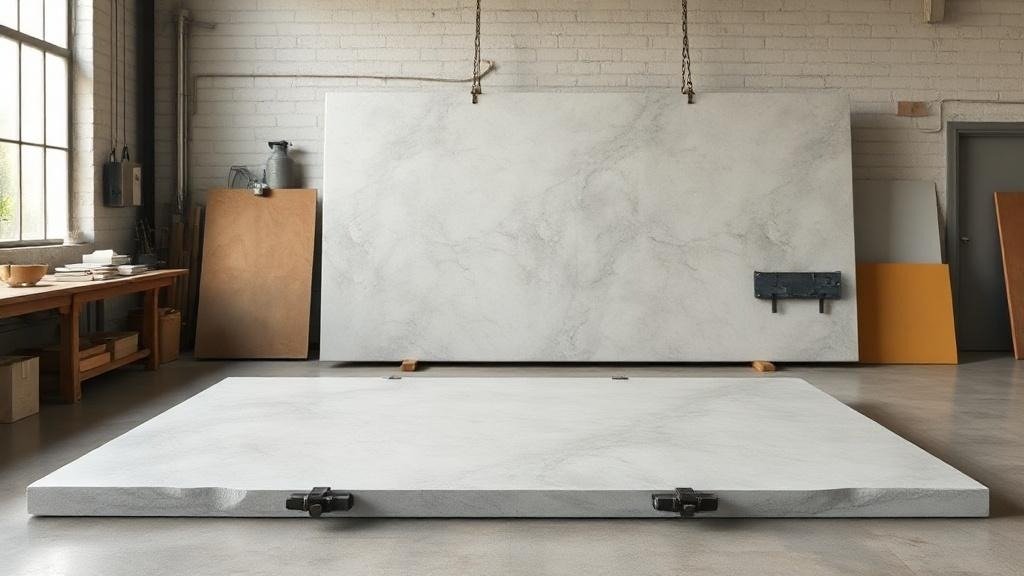
Dimensional standards. Most quartz and granite slabs in 2026 run roughly 56 by 120 inches in 2cm or 3cm thickness. Marble for residential kitchens almost always needs 3cm to avoid flex-related cracking. Knowing this cold means your templater and your salesperson are speaking the same language, which matters more than people think.
Price tier. Installed costs in 2026 roughly break down like this: granite $38 to $115 per square foot, quartz $55 to $130, quartzite $80 to $180, marble $60 to $200. Wide ranges, yes, but even the ranges are useful. A customer who walked in expecting to spend $60 a square foot on Calacatta Gold marble needs to be redirected before you waste a templating visit.
Why Quartzite Costs What It Costs (and Why Customers Keep Asking)
This is the question I hear most from shop owners relaying customer conversations. Quartzite looks like marble to most homeowners, so they don’t understand the price gap versus granite.
The answer is simple: it’s harder to work. Quartzite at Mohs 7 to 7.5 chews through blades faster, takes longer to cut, and demands more careful edge finishing than granite at 6 to 6.5. Your shop-side labor cost per square foot is meaningfully higher. Add that roughly 78 percent of natural stone supply comes from Brazil, India, Turkey, and Italy, and quartzite sourcing from Brazil in particular carries freight and tariff premiums that granite from India does not.
Shops that can explain this clearly, without apology, close more quartzite jobs. The customer who understands they’re paying for a harder, more durable, more labor-intensive material feels better about the number than the customer who just sees a big invoice and wonders if they’re being marked up.
The Business Case: Conversion, Callbacks, and Margin
I’ll be opinionated here: if your salespeople can’t explain the difference between quartzite and marble in two sentences, you are leaving 10 to 15 percent of your potential revenue on the table. That’s not a guess. Shops with documented material reference material report up to 14 percent improvement in showroom-to-quote conversion, based on case studies of mid-sized residential operations.
The callback numbers are even more striking. Shops with disciplined material education report up to 40 percent reduction in material-related callbacks. That’s callbacks for etching on marble that the customer didn’t expect, heat marks on quartz counters, color variation on natural stone that “doesn’t match the sample.”
Every one of those callbacks is a margin killer. The fabricator who drives out to look at a heat ring on a quartz counter, then has to explain (again) that hot pans above 300 degrees damage resin, has just spent two hours and a tank of gas on a conversation that should have happened in the showroom.
Margin protection also shows up in material steering. A salesperson who genuinely understands material properties can guide a heavy-use kitchen customer toward quartzite or granite rather than letting them fall in love with a soft marble that will etch the first time someone sets a lemon slice on it. That’s not upselling. That’s saving yourself a phone call eighteen months from now.
See also: Multi-Cloud Strategy for Enterprises
Building the Reference: 60 to 90 Days, Part-Time
The implementation here is not complicated. It’s just work.
Weeks 1 through 4: The owner or senior salesperson builds the internal reference document. One document. It covers material categories (granite, marble, quartzite, soapstone, travertine, engineered quartz, porcelain), properties, dimensions, pricing tiers, and common customer misconceptions. Major engineered quartz brands (Cambria, Silestone, MSI Q, Caesarstone, Cosentino) get their own subsections because customers walk in asking brand-specific questions.
Weeks 5 through 8: Salesperson training. Each person works through the reference, role-plays common customer conversations, and gets quizzed. This sounds like overkill for a four-person shop. It isn’t. The salesperson who hesitates on quartzite hardness versus granite hardness loses the informed customer.
Weeks 9 through 12: Customer-facing materials. Web content, showroom displays, in-quote inserts. The language has to match the internal training. If your internal reference calls it “resin damage above 300°F” but your website says “heat resistant,” you’ve created a contradiction the customer will find.
The typical investment is 8 to 14 weeks of part-time effort by the sales lead. Payback on conversion and callback improvements runs 12 to 18 months at typical residential volume. That’s a better ROI than most equipment purchases.
Where Vendor Literature Falls Short
Vendor-supplied material literature from Cambria, Silestone, MSI, and others is useful but narrow. It covers brand-specific content well. It does not cover the broader category education that customers actually need.
A customer comparing Silestone quartz to natural quartzite needs cross-category knowledge that no single vendor is going to provide (because the vendor wants you to sell their product, not the competitor’s). The shop-specific layer, your slab inventory, your regional pricing, your supplier relationships, has to come from you.
Trade associations like the Natural Stone Institute and the International Surface Fabricators Association offer good foundational education resources. Pair those with your own shop-specific reference and you have something that actually works on the sales floor.
A Note on Porcelain
Porcelain slabs deserve a separate mention because they’re gaining market share and confusing customers. Porcelain offers higher heat tolerance than engineered quartz and genuine outdoor durability. But it’s thinner, more demanding to fabricate, and the install requires different adhesive protocols. Shops adding porcelain to their lineup need to update their material reference accordingly, not just bolt it onto the quartz section and call it done.
Safety (Because the Production Floor Is Always Part of the Conversation)
Even a material-knowledge discussion has to acknowledge the production side. Slabs at 56 by 120 inches in 3cm thickness commonly weigh 600 to 900 pounds. Vacuum lift handling and forklift operation in slab yards are governed by OSHA general industry standards.
More critically, stone fabrication generates respirable crystalline silica dust on any cutting or grinding operation. OSHA 29 CFR 1926.1153 sets the permissible exposure limit at 50 micrograms per cubic meter as an 8-hour time-weighted average. Salespeople don’t work the production floor, but they should understand this standard well enough to answer customer questions about fabrication practices. Increasingly, customers ask.
When to bring in outside expertise: Owners weighing major operational changes (platform purchases, equipment investments, multi-location expansion) benefit from a trade-experienced consultant or shop peer review before committing capital. The Natural Stone Institute and ISFA both offer member networks for benchmarking.
Frequently Asked Questions
Q: Why does quartzite cost more than granite? A: Quartzite is harder (Mohs 7 to 7.5 versus granite at 6 to 6.5) and more demanding to fabricate, which raises shop-side labor cost. Sourcing and freight premiums, particularly from Brazilian quarries, add to the gap.
Q: How heat-resistant is engineered quartz? A: Engineered quartz handles everyday cooking exposure, but resin damage can occur above roughly 300 degrees Fahrenheit. Hot pans should go on trivets, full stop.
Q: Do all stone materials need sealing? A: Most natural stones (granite, marble, quartzite) require periodic sealing, anywhere from annually to every three years depending on porosity. Engineered quartz does not require sealing.
Q: How does porcelain compare to quartz for countertop use? A: Porcelain offers higher heat tolerance and outdoor durability but is more demanding to fabricate and install due to slab thinness and different adhesive requirements.
Q: How are slab dimensions standardized in 2026? A: Most quartz and granite slabs run roughly 56 by 120 inches in 2cm or 3cm thickness across major brands. Some jumbo formats exist but are not standard for residential work.
Q: How long does it take to build an internal material reference? A: Typically 8 to 14 weeks of part-time work by the sales lead or owner. Most shops see measurable conversion improvements within 12 months of rollout.
Q: What’s the single most common material-related callback? A: Etching on marble and heat damage on engineered quartz, both of which result from expectations that should have been set during the sales conversation.
Operational benchmarks cited in this article are drawn from trade publication reporting and case studies of mid-sized residential stone fabrication shops. Results vary by shop size, market, and operational discipline.